
Rotary Kiln Shell Cooling
Gentle, targeted hot-spot cooling of rotary kiln shells with Mini-AirMace™ atomized water-impulse firing.
The problem: kiln shell hot spots
Rotary kilns run hotter and less predictably as plants burn more alternative and secondary fuels. Uneven combustion, lost coating, and refractory wear create localized hot spots on the kiln shell — zones where the steel runs far above its surroundings.
Left unmanaged, hot spots accelerate refractory failure, risk shell deformation, and can force an unplanned kiln stop. The goal is to pull a specific hot zone back to a safe shell temperature — quickly, but without shocking the steel — while the kiln keeps turning.
Talk to an Engineer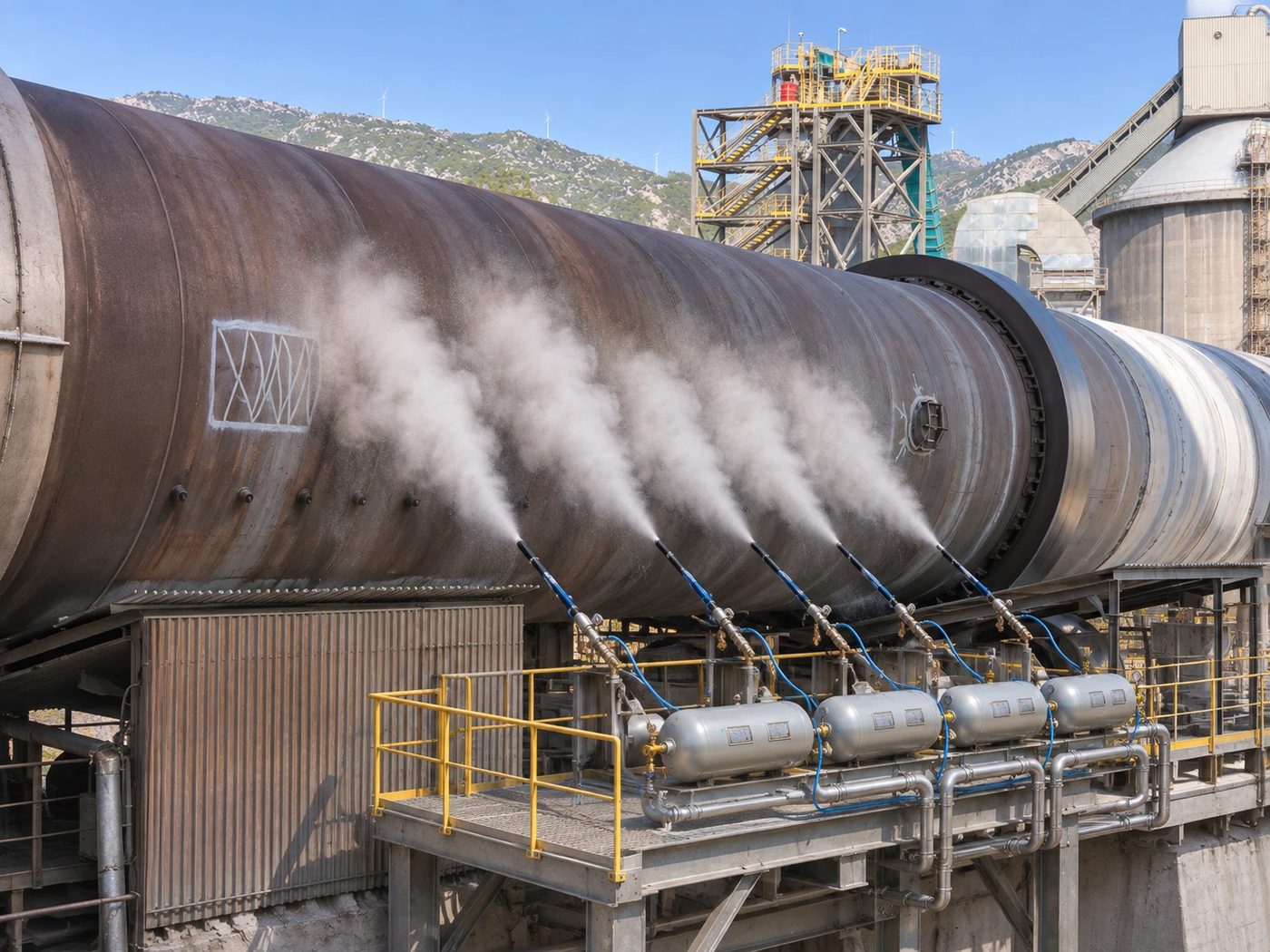
How Mini-AirMace™ atomized-impulse cooling works
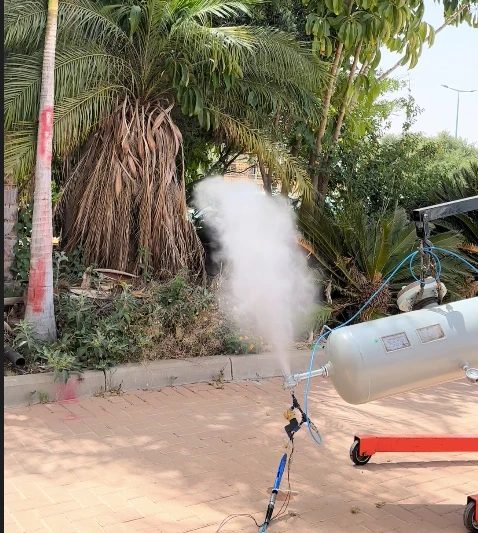
Mini-AirMace™ is a compact air cannon. For kiln-shell cooling it fires a brief, high-energy impulse of compressed air that atomizes a metered charge of water into very fine droplets and carries them, aimed, onto the hot spot.
Fine droplets are the key. Their very high surface-area-to-volume ratio lets them flash-evaporate on contact, pulling heat out of the steel through the latent heat of vaporization — a powerful cooling effect per drop of water — while spreading that effect evenly across the zone. Because the water arrives as a fine mist rather than a coarse jet or a running film, it cools gently and uniformly instead of quenching the surface, and it leaves no standing water on the shell. The result is the combination hot-spot cooling has always had to trade off: gentle, yet powerful.
Firing is intermittent and on demand, so only the targeted zone is treated and only when needed. The unit's compact, portable form lets it be positioned and aimed at a specific hot zone, and firing can be triggered manually or from kiln-shell temperature monitoring. It applies the same compressed-air-and-water impulse principle behind Flow Industries' AirMace™ and MultiPulse™ systems — here directed at localized cooling rather than deposit removal.
Mini-AirMace™ vs fan cooling vs continuous water cooling
Three methods are used to pull a kiln-shell hot spot back to a safe temperature: fan cooling blows ambient air across the shell; continuous water spray wets the hot zone with controlled nozzles; and Mini-AirMace™ atomized impulse fires short, aimed pulses of finely atomized water. They differ most in how the water reaches the steel — which drives how gently they cool — and in how precisely they target a hot spot and how much water and energy they consume.
| Fan (air) cooling | Continuous water spray | Mini-AirMace™ water impulse | |
|---|---|---|---|
| Water delivery | No water — moving air only | Liquid spray that wets the shell in a film | Finely atomized droplets — a fine mist, not a jet or film |
| Heat removal | Air's low heat capacity means large airflow is needed for modest cooling | Water's latent heat removes heat efficiently where it is sprayed | Fine droplets flash-evaporate on contact — high heat removal per drop of water |
| Gentleness on the shell | Gentle, but weak and slow | Depends on dosing control; a liquid film and standing water can cool unevenly | Fine mist cools gently and evenly — powerful without a coarse quench or standing water |
| Hot-spot targeting | Broad — hard to confine to one zone on the circumference | Targeted — individual nozzles cool only the detected spot | Targeted — aimed directly at the hot zone, portable to where it is needed |
| Water use | None | Continuous while a nozzle is active; shell is kept wet | Intermittent, metered pulses — the shell is not kept continuously wet |
| Installed power | High — large fans run continuously | Low — pumps and dosing valves | Low — compressed-air pulses; no large continuous fans |
| Noise | High, continuous fan noise | Low | Brief pulse sound rather than continuous noise |
| Footprint & retrofit | Large fans and ducting | Fixed nozzle arrays along the shell | Compact and portable — easy to position on an existing kiln |
| Control | Usually broad on/off | Closed-loop from infrared shell-temperature sensors | Fired on demand; can be triggered from kiln-shell temperature monitoring |
Comparison of cooling methods for rotary kiln shell hot spots. Fan- and water-cooling characteristics reflect widely reported industry practice; the Mini-AirMace™ column describes the engineering principle of atomized-impulse cooling. The right method for a given kiln depends on its size, hot-spot severity, and available air and water utilities.
Where it fits
- Localized kiln-shell hot spots
- Plants burning alternative or secondary fuels
- Retrofits where large fans or fixed nozzle arrays are impractical
- Protecting coating and refractory to extend campaign life
Engineered to the kiln
Atomization is what makes the cooling gentle — fine droplets flash-evaporate instead of quenching the steel. Droplet charge, firing rate, and aim are then set to the specific kiln and hot-spot condition to hold that balance of gentle and powerful.
Send us your kiln size, shell-temperature data, hot-spot history, and available air and water utilities, and our engineers will advise whether a Mini-AirMace™ atomized-impulse arrangement suits your case.