
Dust Suppression
A different approach — a high-momentum AirMace® air–water pulse carrying a broad range of droplet sizes to the dust at its source.
The problem: one dust cloud, many particle sizes
Crusher discharge points, conveyor transfers, and other material-handling operations throw up dust clouds that contain a wide range of particle sizes at once — from coarse grit to fine airborne PM10 (≤10 µm) and PM2.5 (≤2.5 µm).
Conventional methods each handle only part of that range. Sprinklers produce mostly coarse droplets that wet bulk material well but collect fine airborne dust poorly. Dry-fog systems do the opposite — very fine droplets for airborne capture, but with little momentum to penetrate a large, turbulent cloud or wet coarse material.
Talk to an Engineer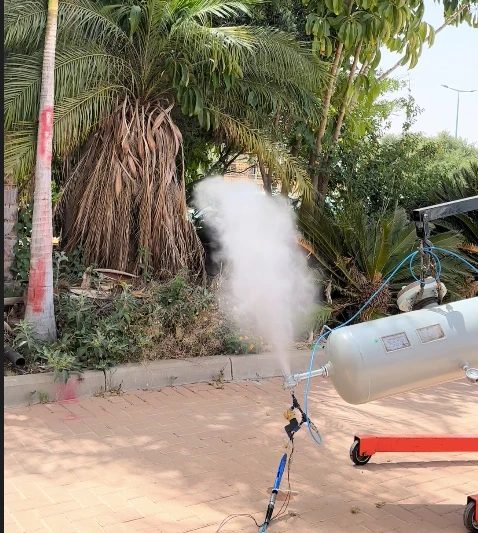
How AirMace® dust suppression works
AirMace® combines a powerful compressed-air pulse with water injection to generate a high-momentum air–water blast that contains a broad distribution of droplet sizes — rather than optimizing for fine fog or coarse spray alone. Different fractions of that spray do complementary jobs:
Small droplets
A large collection surface area for fine airborne dust (PM10 / PM2.5).
Medium droplets
A balance of particle interception and greater momentum.
Large droplets
Penetrate the cloud and wet coarse dust and material surfaces.
High-energy air pulse
Carries the water into the region where dust is being generated.
The compressed-air blast is designed to deliver the pulse over an effective reach of roughly 5–15 m (design target 10–15 m). Unlike low-momentum fog, droplets carried by the blast acquire substantial velocity — designed to improve penetration into turbulent dust clouds and reduce sensitivity to crosswinds.
AirMace® vs sprinklers vs dry fog
AirMace® aims to combine the strengths of both conventional approaches in one pulsed air–water system — broad droplet range, high momentum, and simple utilities.
| Conventional sprinklers | Dry fog | AirMace® | |
|---|---|---|---|
| Droplet distribution | Predominantly coarse | Predominantly fine | Broad — fine, medium and coarse together |
| Fine dust capture | Limited to moderate | Favorable | Favorable |
| Coarse material wetting | Good | Limited | Good |
| Long-range penetration | Depends on spray | Generally limited | High-momentum pulse, 10–15 m design target |
| Wind resistance | Moderate, geometry-dependent | Often sensitive | Designed for improved resistance |
| Water pressure | Low to moderate | Depends on technology | Ordinary tap pressure — no high-pressure pump |
| Water-quality requirements | Generally moderate | Often higher for fine nozzles | Moderate — no exceptionally fine nozzles |
| Principal operating energy | Water pumps or supply pressure | Compressed air and/or pumps | Compressed air |
| Dust-suppression performance | Established | Established | Requires comparative field validation |
Comparison of dust-suppression technologies. AirMace® characteristics describe the design intent of the pulsed air–water approach; dust-suppression performance for a given dust and site should be confirmed by comparative field validation.
Simple utilities
- Water at ordinary tap pressure — no high-pressure pumping station
- Compressed air as the principal operating energy
- No exceptionally fine fogging nozzles — less prone to clogging
- Can use existing mine compressed-air infrastructure, where suitable
Where it's used
- Crusher discharge points, crushers and screens
- Conveyor transfer points and drop chutes
- Stockpiles, loading/unloading and storage yards
- Demolition work and unpaved haul roads
A new approach — matched to your site
AirMace® dust suppression is a new application of our air–water impulse technology, and its performance should be established for each dust and site by comparative field validation. Send us the material, the dust source, and your site conditions, and our engineers will advise whether an AirMace® arrangement suits your case.